
Namibia's property prices continue to rise, but sales are slowing

Senior Editor
Published 12 November 2026
·8 min read
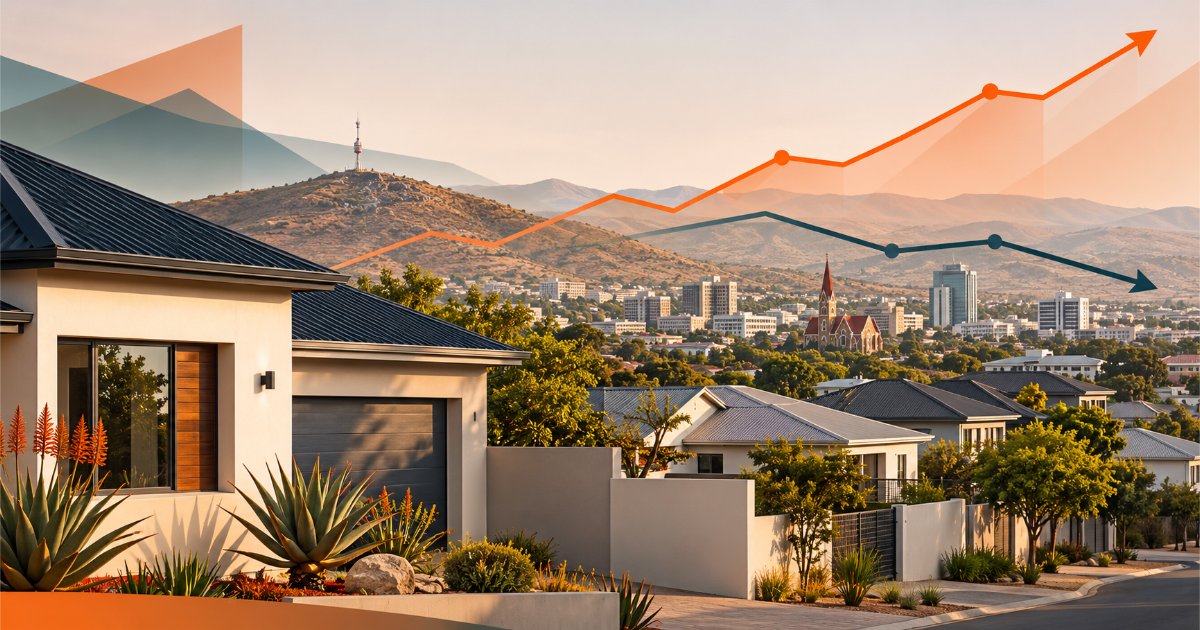
Namibia's residential property market recorded stronger house price growth in the third quarter of 2026, with the national average reaching N$1.5 million and Windhoek's average rising to N$1.85 million. However, declining transaction volumes suggest that rising property prices are not necessarily translating into stronger market activity.
According to the latest FNB Namibia House Price Index, national house price growth accelerated to 8.9% on a 12-month moving average basis during the third quarter of 2026. This was up from 7.4% in the previous quarter and 5.9% during the corresponding period in 2025.
The national weighted average house price reached N$1,502,539, compared with N$1,461,215 in the second quarter and N$1,380,042 a year earlier. Windhoek recorded particularly strong annual growth, with the capital's average house price increasing by 17% to approximately N$1.85 million.
However, while property prices continued to rise, national property transaction volumes declined by 3%, reversing the growth recorded in the previous quarter.
The figures point to a property market where limited housing supply continues to support prices, even as buyer activity slows.
Windhoek's average house price reaches N$1.85 million.
Windhoek remains one of Namibia's most expensive residential property markets, with average prices increasing significantly over the past year.
The capital's average house price rose from N$1,579,673 in the third quarter of 2025 to N$1,848,267 in the third quarter of 2026. This represents an increase of approximately N$269,000 over 12 months.
Despite the strong annual performance, Windhoek recorded a slight quarterly decline of 1.2%, with the average price easing from N$1,871,379 in the second quarter. The difference between annual and quarterly movements is important. While the longer-term trend points to higher prices, the quarterly decline suggests that price growth is not uniform.
It is also worth remembering that average house prices reflect the properties included in recorded transactions. They are useful for understanding overall market direction but do not mean every home in Windhoek has increased in value by 17%.
Individual property values will continue to depend on location, condition, size, property type and demand within a particular neighbourhood.
How house prices are performing across Namibia
The latest FNB figures show considerable differences in price growth across Namibia's four regions.
Central Namibia recorded the strongest annual growth, followed by the coastal and northern regions. The southern region was the only one to experience an annual decline in average house prices.
| Region | Average house price | Annual price growth |
|---|---|---|
| Central | N$1.94 million | +11.4% |
| Coastal | N$1.53 million | +3.7% |
| Northern | N$991,000 | +1.6% |
| Southern | N$892,000 | -3.4% |
Central Namibia leads the market
Central Namibia, which includes Windhoek, remained the strongest-performing residential property region during the third quarter.
Annual house price growth accelerated to 11.4%, up from 8.9% in the second quarter, bringing the regional average to approximately N$1.94 million. The region also accounted for 48.2% of national property transactions, compared with 37.8% in the previous quarter.
This concentration highlights the central region's importance to Namibia's residential property market, although transaction volumes within the region declined by 3.9% on a 12-month moving average basis.
Coastal property price growth moderates
The coastal region recorded annual house price growth of 3.7%, down from 11.9% in the second quarter.
Average house prices reached approximately N$1.53 million. Although this represents a slowdown in the pace of price increases, prices remain higher than a year earlier. Property transaction growth in the region was flat at 0%, compared with 7.4% in the second quarter, pointing to slower market activity.
Northern Namibia returns to positive growth
House prices in northern Namibia increased by 1.6% during the third quarter, following a 0.7% decline in the previous quarter. The average residential property price reached approximately N$991,000.
While price growth returned to positive territory, transaction volumes declined by 9.5%, indicating that buyer activity remains subdued.
Southern Namibia remains under pressure
The southern region recorded a 3.4% annual decline in average house prices, following a 5.2% contraction in the previous quarter.
The regional average stood at approximately N$892,000, making it the most affordable of the four regions based on average recorded prices. Transaction volumes declined by 25%, although the relatively small number of sales in this region means that percentage changes can be particularly volatile.
The region accounted for only a small share of national property transfers, making individual transactions more influential in overall market measurements.
Property prices are increasing across all housing segments
The latest figures also show that annual price growth was positive across all four housing categories measured by FNB.
Luxury homes recorded the strongest growth, followed by small homes, large homes and medium-sized properties.
| Housing segment | Annual price growth | Average price |
|---|---|---|
| Small homes | +3.9% | N$956,000 |
| Medium-sized homes | +1.9% | N$2.17 million |
| Large homes | +3.6% | N$4.48 million |
| Luxury homes | +6.2% | N$8.53 million |
The luxury housing segment recorded annual growth of 6.2%, while medium-sized properties experienced the slowest growth at 1.9%.
These differences highlight the importance of looking beyond national averages when assessing the property market.
A buyer searching for a smaller home in Windhoek, for example, may experience very different market conditions from someone looking for a luxury property along the coast. Similarly, sellers need to consider the performance of comparable properties in their immediate area rather than relying on national house price movements when setting an asking price.
Property transactions decline despite rising prices
One of the more significant findings in the third-quarter report is the growing difference between house price growth and transaction activity.
While national house prices increased by 8.9%, property transaction volumes contracted by 3% on a 12-month moving average basis. This reverses the 2.8% growth recorded in the second quarter of 2026 and represents a considerable slowdown from the 18.4% growth recorded during the third quarter of 2025.
The figures suggest that rising property prices are being supported more by limited available housing stock than by increasing buyer activity. FNB Namibia identifies several supply-related factors contributing to higher prices, including the limited availability of homes, shortages of serviced residential land and elevated construction costs.
At the same time, the combination of higher property prices and financing costs is making it more difficult for some households to enter the market. For homeowners considering selling, the difference between price growth and transaction activity is particularly relevant.
Although average property values have increased, this does not necessarily mean homes are selling more quickly or that buyers are willing to pay substantially higher asking prices. Local demand, pricing and the availability of competing properties remain important considerations.
Residential land sales fall as plot prices rise
The supply of serviced residential land remains one of the key challenges facing Namibia's property market. According to FNB, national residential plot sales declined by 15.5% on a 12-month moving average basis during the third quarter.
Although this was an improvement on the 26.7% decline recorded in the second quarter, it indicates that activity in the residential land market remains under pressure. Despite fewer plot transactions, land prices increased across all four regions.
Central Namibia recorded an 8.5% increase in average residential land prices to approximately N$1,003 per square metre. The coastal region recorded an increase of 18.2%, while prices in northern Namibia rose by 18%. Southern Namibia registered the strongest increase at 53.8%, although FNB cautioned that the smaller size of the market makes it more susceptible to significant percentage fluctuations.
The continued increase in residential land prices is important because it influences the cost of developing new housing. Limited serviced land availability can delay residential development and restrict the supply of new properties, particularly in areas where demand is already concentrated.
Until the availability of developable residential land improves, supply constraints are likely to remain an important factor influencing property prices.
What do the latest figures mean for Namibia's property market?
The third-quarter figures suggest that Namibia's residential property market is experiencing stronger price growth without a corresponding increase in sales activity.
For buyers, this makes local market research particularly important. National averages provide a useful indication of broader trends, but property prices can differ considerably between regions, towns, neighbourhoods and property types.
For sellers, the latest figures reinforce the importance of realistic pricing. Strong annual growth in average house prices does not guarantee that every property will achieve a higher selling price. Understanding recent comparable sales and current buyer demand remains essential.
Estate agents can also use the regional data to provide clients with a clearer picture of market conditions, particularly when discussing pricing expectations and the availability of suitable properties.
What is the outlook for Namibia's property market heading into 2027?
Looking ahead, FNB Namibia expects property prices to remain elevated as housing supply shortages continue.
The limited availability of serviced land, slow delivery of new residential stock and high construction costs are expected to remain significant influences on the market. However, higher financing costs and pressure on household budgets could continue to restrict buyer activity.
The Bank of Namibia's recent increase in the repo rate to 7% may also affect mortgage affordability, particularly for households already facing higher living expenses. While mortgage credit growth improved to 2.8% year-on-year in August 2026, overall growth remained relatively subdued. As a result, property market performance may continue to differ significantly between regions and housing segments.
Areas with limited available stock may experience continued price pressure, while markets with weaker demand could see slower price growth or further adjustments.
A market shaped by supply and changing buyer activity
Namibia's third-quarter housing figures highlight a residential property market where prices continue to rise, but market activity is becoming more subdued.
The national average house price has reached N$1.5 million, Windhoek has recorded 17% annual growth, and central Namibia continues to lead regional performance. However, declining transaction volumes and continued constraints in residential land delivery suggest that the market faces challenges beyond property price growth.
For buyers, sellers and property professionals, understanding these differences will be important when making decisions heading into 2027.
Whether you're comparing property prices, exploring a new area or considering selling your home, local market conditions remain just as important as national trends.
Explore properties for sale across Namibia on MyProperty Namibia and connect with local estate agents who understand the market in your preferred area.
Source: FNB Namibia House Price Index, Third Quarter 2026. Figures reported by The Brief, Namibian Sun and other Namibian property market publications in November 2026. Figures are rounded where indicated.
Never miss a property story
Get our latest news straight in your Google feed.
More in Market
The cost of keeping a home in Namibia: September 2026 inflation
Namibia's annual inflation rate rose to 5.4% in September 2026, up from 3.5% a year earlier and the highest reading in the past 12 months. Most of that jump came from fuel and transport, not from housing.
Read more →
What Namibia built in July 2026: The coast leads and renovations keep climbing
Buildings worth N$103.5 million were completed in Namibia's four biggest reporting towns in July 2026, according to the latest Buildings Completed report from the Namibia Statistics Agency (NSA). The coast did most of the building, home completions held steady against last year, and renovations rose...
Read more →
Ask these questions to find out more about what is happening in your property market
Whether you’re buying, selling, or simply curious about your neighbourhood’s property trends, a conversation with a qualified real estate expert can give you clarity you won’t find online. Local agents track micro-market shifts, upcoming developments, and buyer behaviour long before the data becomes...
Read more →The cost of keeping a home in Namibia: September 2026 inflation
Namibia's annual inflation rate rose to 5.4% in September 2026, up from 3.5% a year earlier and the highest reading in the past 12 months. Most of that jump came from fuel and transport, not from housing.
Read more →What Namibia built in July 2026: The coast leads and renovations keep climbing
Buildings worth N$103.5 million were completed in Namibia's four biggest reporting towns in July 2026, according to the latest Buildings Completed report from the Namibia Statistics Agency (NSA). The coast did most of the building, home completions held steady against last year, and renovations rose...
Read more →Ask these questions to find out more about what is happening in your property market
Whether you’re buying, selling, or simply curious about your neighbourhood’s property trends, a conversation with a qualified real estate expert can give you clarity you won’t find online. Local agents track micro-market shifts, upcoming developments, and buyer behaviour long before the data becomes...
Read more →